
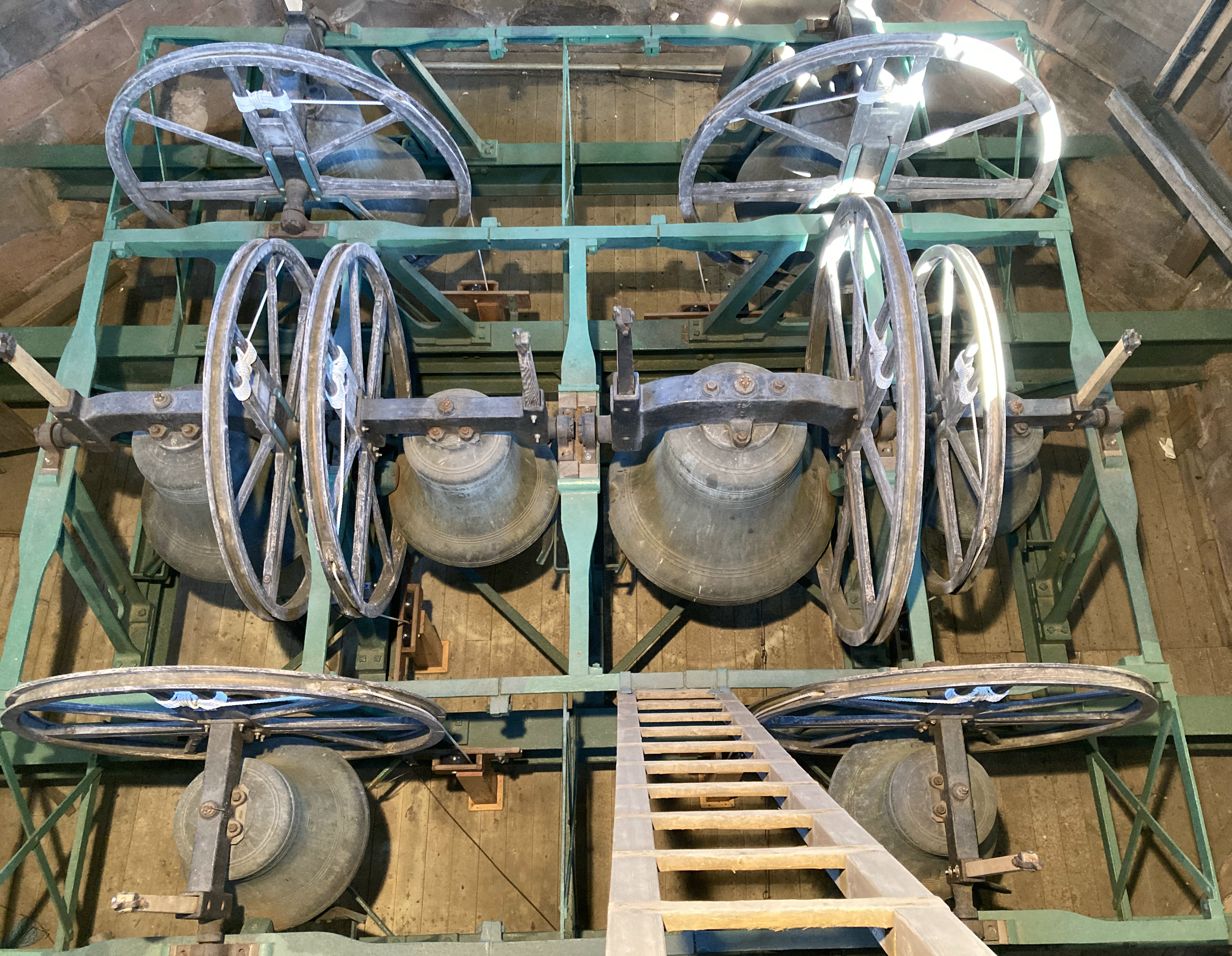
There are eight bells in the belfry. The four older ones remain from a ring of six bells cast for the tower by Abraham Rudhall of Gloucester in 1713. In 1922, Rudhall’s bells were taken to the foundry of John Taylor in Loughborough where two were recast and two new bells were cast to create a ring of eight bells. All the bells were then tuned (except the seventh) and returned to Nantwich in early 1923 and rehung in a new cast iron frame (as seen here from above).
Dates, Founders and Inscriptions
This table lists the bells and shows the years in which they were cast, the foundry (or bell founder) who cast them, and the inscriptions they bear. The bells are listed from the Treble to the Tenor (the highest toned to the deepest toned bell). Roman numerals are used to denote each bell just because these were used on one of the old “weights boards” which display this sort of information in the tower.
| Bell | Cast | Founder | Inscription |
|---|---|---|---|
| I | 1922 | John Taylor & Co | A. HINDE E. C. GROCOTT CHURCHWARDENS. 1922 |
| II | 1922 | John Taylor & Co | W. SUTTON W., A., H., T. & A. STUBBS E. H. STEVENTON H. EDWARDS A. JERVIS BELLRINGERS. 1922 |
| III | 1922 | John Taylor & Co | PROSPERITY TO THIS TOWN & PARISH AΩR 1713 RECAST 1922 |
| IV | 1922 | John Taylor & Co | PEACE & GOOD NEIGHBOURHOOD AΩR 1713 RECAST 1922 |
| V | 1713 | Abraham I Rudhall | ABR: RUDHALL CAST US ALL 1713 |
| VI | 1713 | Abraham I Rudhall | GOD SAVE THE CHURCH AND QUEEN ANN AΩR 1713 |
| VII | 1713 | Abraham I Rudhall | PROSPERITY TO ALL OUR BENEFACTORS AΩR 1713 |
| VIII | 1713 | Abraham I Rudhall | THO: TALBOT HUMPHREY HAYLES CHURCHWARDENS AΩR 1713 |
| 8 | |||
Inscription Notes

All the text and other decoration on the bells is actually cast in relief rather than being inscribed, but the term inscription> is generally used to describe it. The process used in 1713 involved attaching wax blocks for each character to a wax model of a bell by hand and then using this model to create the mould. This process must have been difficult in those days and you can see unevenness with the orientation and spacing of the characters and there is evidence of the edges of some of the blocks (click on the image to expand it). It is not unusual to see some characters inverted by mistake on some bells, but not on our fine bells at Nantwich!

The Ω between the A and R in some of the inscriptions in the table above is there to represent Abraham Rudhall’s founder’s mark which looks like a small bell. The bell seen here in the image of Rudhall’s mark still has its crown; the crowns from his bells at Nantwich were removed during their visit to Taylor’s foundry in 1922, as it made hanging them from cast iron headstocks easier.

The two bells inscribed “Recast 1922” were newly cast in 1922, but using a mould taken from the original bells. You will note here that Taylor’s type-setting is much more regular than Rudhall was able to achieve. In the recasting process, Taylor’s tidied up some of the circular lines on the recast bells and produced a smoother surface for the bells, but they left Rudhall’s text and fancier decorations as these originally appeared.
Weights and Other Data
Bell ringers are particularly interested in the weights of the bells, which are shown in the following table. The table also shows the note and frequency of the fundamental tone (or nominal) of each bell.
These measurements were made in 1922-23 when the bells were augmented to eight by John Taylor’s of Loughborough. The weights were recorded in imperial units, and to help appreciate them approximate metric equivalents are given.
To non-ringers, the first column under the heading Weight will look strange. It shows the weight of each bell in the traditional units of hundredweights (1 cwt = 112 lb), quarters (28 lb) and pounds (lb). NB: 20 cwt is 1 imperial ton, which is ≈16kg more than a metric tonne. Even today, almost without exception, ringers will refer to the weight of bells in these traditional units, and it is rare to see bell weights expressed in metric units in the UK. The total weight of the bells is shown at the bottom of the table.
| Bell | Weight | Nominal | |||
|---|---|---|---|---|---|
| cwt-qtr-lb | lb | kg | |||
| I | 4-2-14 | 518 lb | ≈235kg | E | 1352Hz |
| II | 5-0-0 | 560 lb | ≈254kg | D♯ | 1276Hz |
| III | 5-3-4 | 648 lb | ≈294kg | C♯ | 1136Hz |
| IV | 6-2-0 | 728 lb | ≈330kg | B | 1013Hz |
| V | 8-0-2 | 898 lb | ≈407kg | A | 902Hz |
| VI | 9-0-4 | 1012 lb | ≈459kg | G♯ | 850Hz |
| VII | 12-1-11 | 1383 lb | ≈627kg | F♯ | 758Hz |
| VIII | 14-2-18 | 1642 lb | ≈745kg | E | 675Hz |
| 8 | 65-3-25 | 7389 lb | ≈3351kg | ||
Tuning Notes
Together, the bells in the tower make a complete diatonic octave in the key of E Major.
When the bells were augmented in 1922-23, they were tuned to match the seventh (Rudhall’s fifth, which was not retuned). This resulted in the tenor’s nominal changing from 679Hz (F minus 49 cents) to 675Hz (E plus 41 cents). This small change of a tenth of a semitone tipped the scale of the bells from being in the key of F Major to E Major! This change went unnoticed until it was revealed during the ongoing process of digitising John Taylor’s foundry records in 2019, so for nearly 100 years bell ringers have been thinking the bells they were ringing were in a different key!
The Sounds of the Bells
If you would like to hear the bells being rung in a variety of ways and for a variety of reasons, please click Sounds of the Bells. Here is a snippet to whet your appetite:
Revisions:
| 14/10/2020 | Initial publication (major revision to previous page). |