
The following article about the development of an innovative laminated wooden clapper at Nantwich was written for publication in the Ringing World (the weekly magazine for the worldwide community of church bell ringers) and was published in issue 5727 on 29 January 2021. It is reproduced here for your delectation.
To help non‐ringers appreciate some aspects of the article, here are a few preliminary notes:
- A stay is a piece of ash which is used to rest a bell in its inverted position ready for the next piece of ringing. If the ringer “standing” a bell (putting it to rest on the stay) allows it to hit the stay rather too forcefully, a stay can be broken and will require replacement. Ash is used for stays as it has a very straight grain and the right balance of strength with flexibility to absorb the normal stresses involved in setting a bell. It goes without saying that more stays are broken during the teaching phase of ringing as new ringers are getting used to how little they need to pull on the rope to control their bell. As ringing has been severely curtained during the pandemic, and all teaching has been suspended, the number of stays being broken has clearly fallen. Incidentally, the production of a new stay for a Nantwich bell can take up to three hours (and that's when you have the requisite joinery skills and experience)!
- A clapper is the thing inside a bell which hits the bell during its revolution to produce the sound. Clappers were traditionally made from wrought iron which is no longer produced (except perhaps in industrial heritage museums). New clappers are made using different materials, one such being known as spheroidal graphite steel. Clappers made from spheroidal graphite steel have had a tendency to remain touching the bell after striking for rather too long, due to their shafts being too heavy in proportion to the weight of the clapper's flight (the counterbalance attached to the clapper's ball), leading to a duller sound than that produced by a wrought iron clapper. In recent years, wood has been used for the shaft of new clappers, predominantly for the heavier bells, to rebalance the resultant clapper (ideally the centre of mass of a clapper should be in the centre of the ball to avoid any “stickiness”).
- Lignum vitae is a dense hardwood that is naturally very oily and water-resistant. It can be cut to have very smooth surfaces and it is very hardwearing. It also does not shrink or expand with varying temperature or humidity like some other timbers (it would be good for doors if it wasn't so scarce and oily!). Lignum vitae was traditionally used to form the bush in the clapper bearing. Its use has been succeeded by the use of sintered brass (brass which has holes in it which can hold an amount of oil) and other more modern materials (e.g. Tufnol ‐ a man‐made cotton‐based laminated fabric which can be used in bearings).
Here's the article, at last!
The Ringing World, Issue 5727, 29 January 2021
What shall we do with the furloughed sta'‐'aker?
Whilst I have been delighted that my prowess in tower captaincy has increased enormously during the pandemic, as measured on the number of stays broken during the past year, one of the drawbacks of the pandemic has been that the workload on skilled stay‐makers has also diminished and there is a risk of them finding other things to do with their hands. This doesn't bear thinking about in many ways, so here's a short article that might give stay‐makers (both seasoned and budding) something upon which to hone their skills during lockdown 3.
In the winter of 2014 (I'm beginning to sound like an old git here), David Allman, a lifelong ringer at Nantwich, having finally had more than enough of the clunky sound of our tenors following the replacement of the clappers with spheroidal graphite beasties some years earlier, considered the problem of sourcing and replacing wrought iron clappers. As a professional joiner, David had followed the emergence of wooden clappers with some interest but had not been impressed with certain aspects of the (then) technology, in particular the unimaginative use of solid timber just for the straight part of the shaft and the consequential crude appearance of the finished articles. He thought he could produce something more elegant…
David cut some long thin strips of ash which he then steamed, bent, and glued around a teardrop‐shaped piece of lignum vitae to form something akin to a large wooden split pin. He then secured the ball and part of the shaft of a broken wrought iron clapper between the open ends of this “pin” using a number of 8mm bolts and more adhesive, and drilled a hole through the lignum vitae to form the bearing for a new “wooden” clapper. The whole assembly was then varnished as befits a work of joinery art.
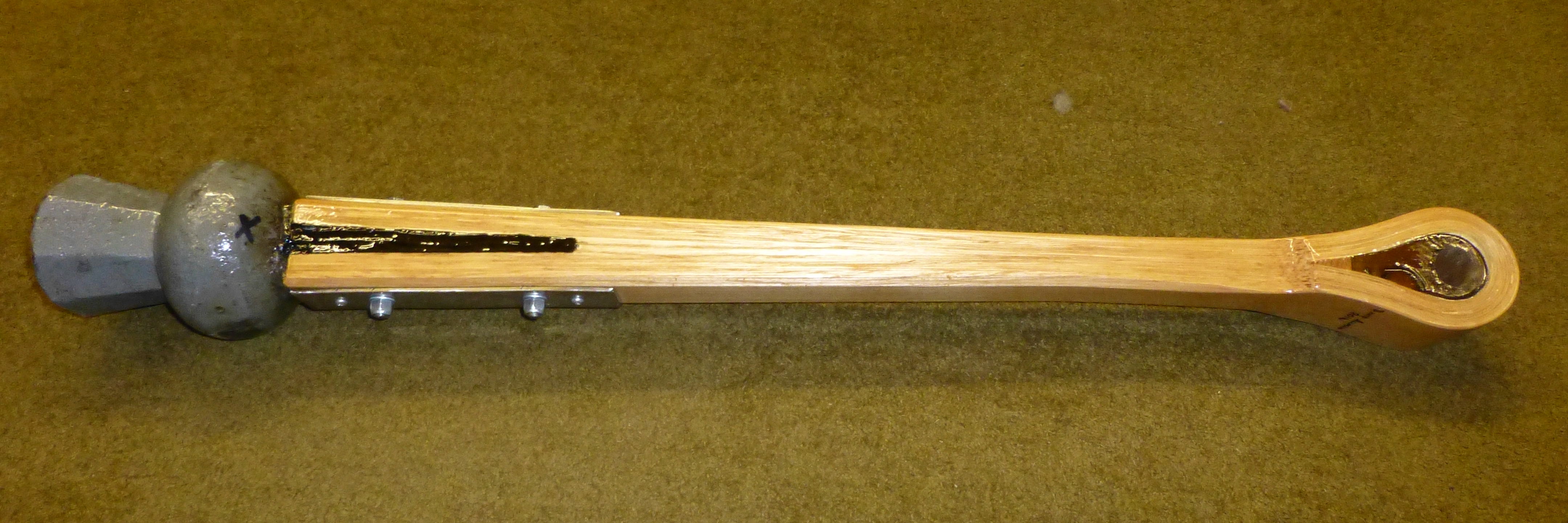
As can be seen in the photos, the appearance of the clapper is excellent; it is almost a pity to hide it away inside a bell! The innovative laminated design exploits the strength and flexibility of ash and should ensure the clapper has a very long lifetime. The use of lignum vitae for the bearing is both a nod to the past and a clever use of another property of a natural material. The only use of metal is for the actual ball and the securing bolts and plates that hold it in situ.
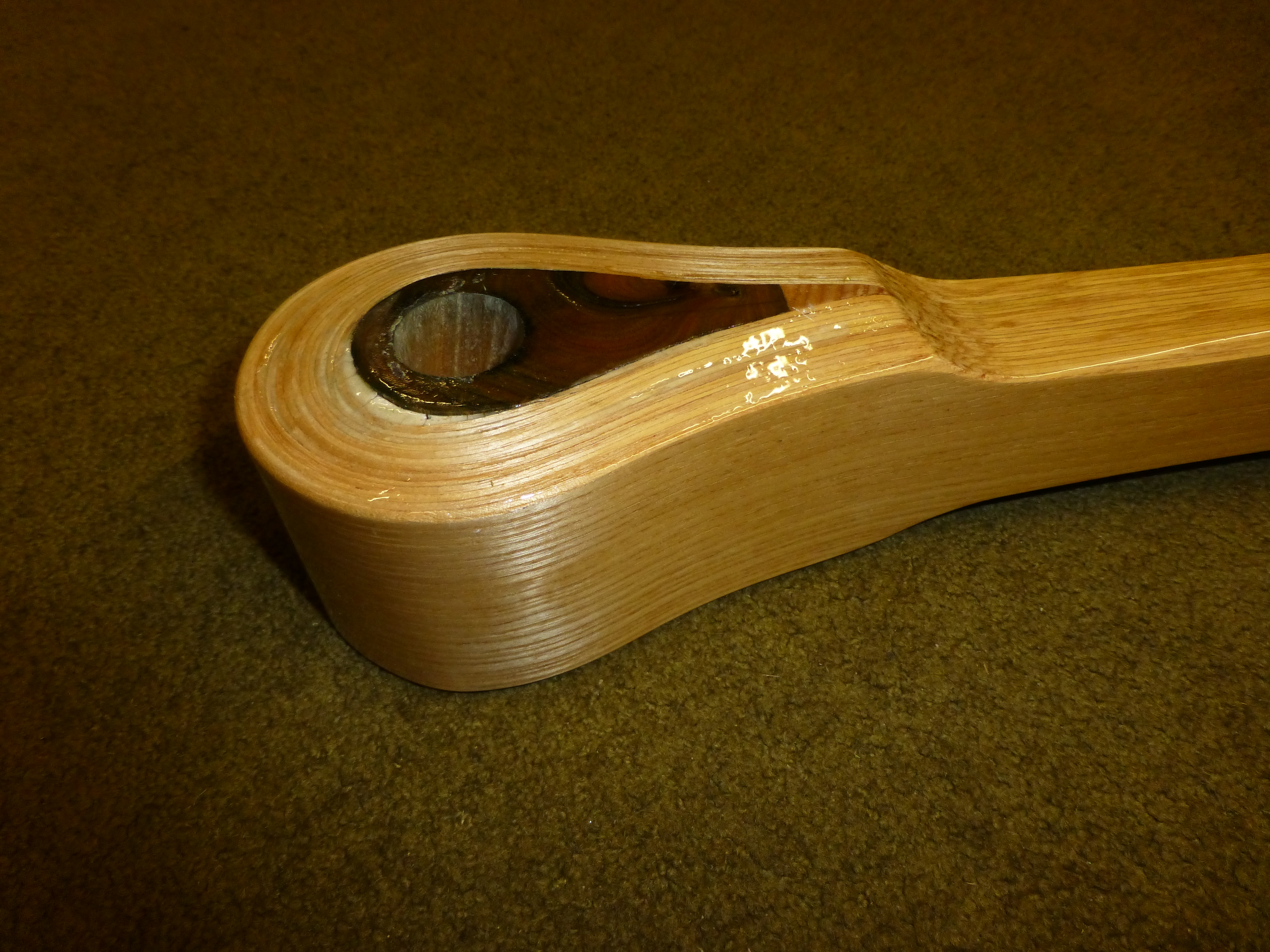
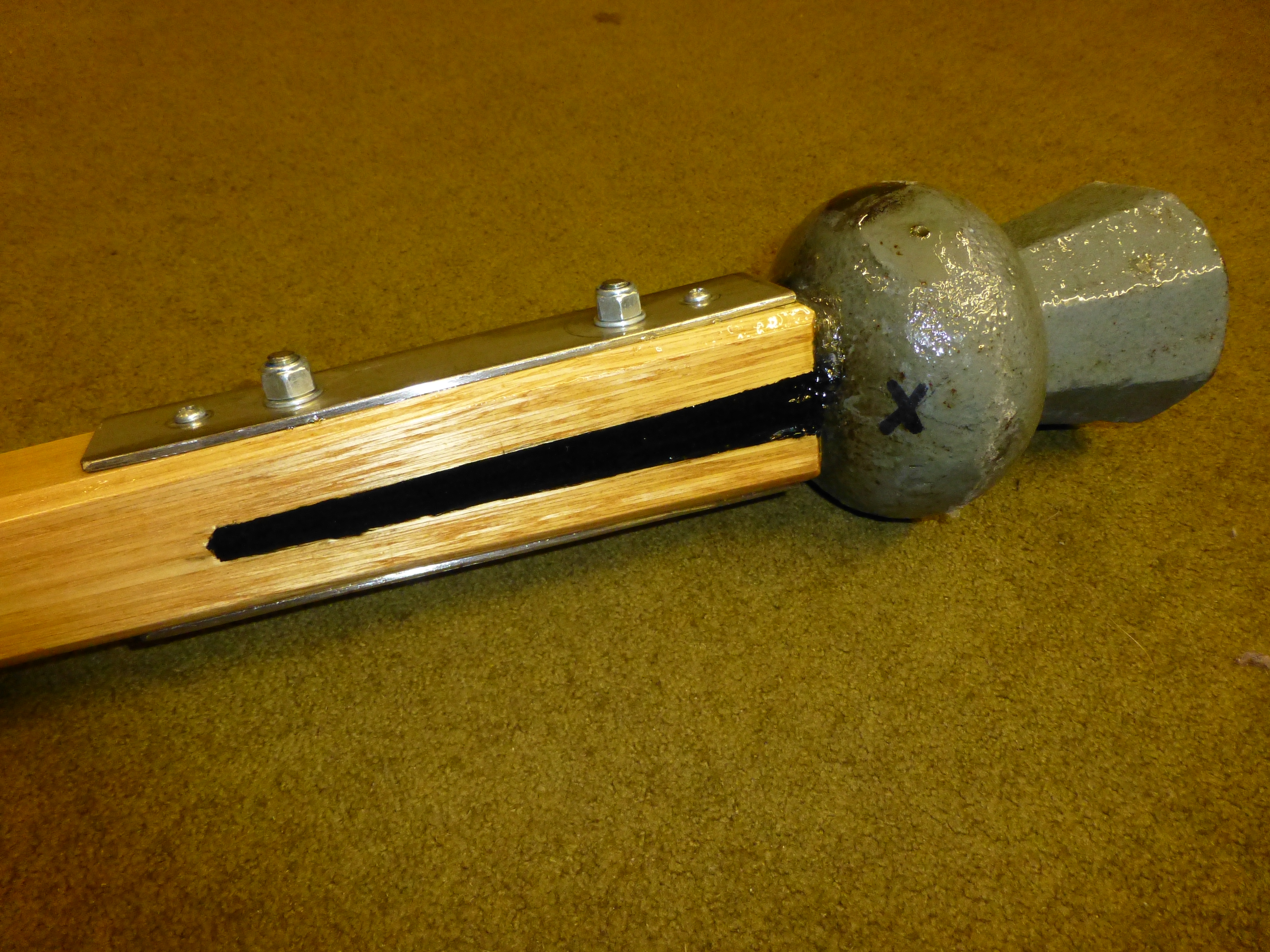
But it's not all about appearance or construction; once installed, the clapper so vastly improved the sound of the tenor, David produced another for the seventh!
Our wooden clappers have been in faithful service for seven years now and have survived a lot of use (including ten peals) with little signs of wear and tear. One modification we had to make over the initial design was to replace the 8mm bolts with 10mm threaded‐rods and nuts as we noticed the heads of the original bolts were shearing off – we suspect this was due to the slight angles between the two plates each side of the clapper putting uneven stress on the heads when the clapper struck the bell. The other modification was to add another precautionary bolt higher up the shaft as the main seam near the top of the shaft showed a little sign of separating (David's supply of bones for the glue must have been poor back in 2014!).

So, any furloughed stay‐makers out there – fancy improving on this design classic?
Stefan Zientek
29 January 2021
PS: Apologies for the title – I've always wanted to use two apostrophes in a word (like fo'c'sle, although I'm pretty sure that should really have three) and, besides, the first line of my fledgling Spring Number 1 hit didn't scan to the tune otherwise!
Revisions:
| 19/02/2021 | Initial publication. |